What race engineering and heavy equipment innovation have in common

2026.7.16
Atlassian Williams Racing

What race engineering and heavy equipment innovation have in common


Ahead of the 2026 Japanese Grand Prix, Atlassian Williams F1 Team Driver Carlos Sainz and Chief Technical Officer Pat Fry visited Komatsu’s Shonan Plant to meet engineers and discuss how data, simulation, thermoelectric technology and collaboration help solve performance challenges on the track and on job sites.
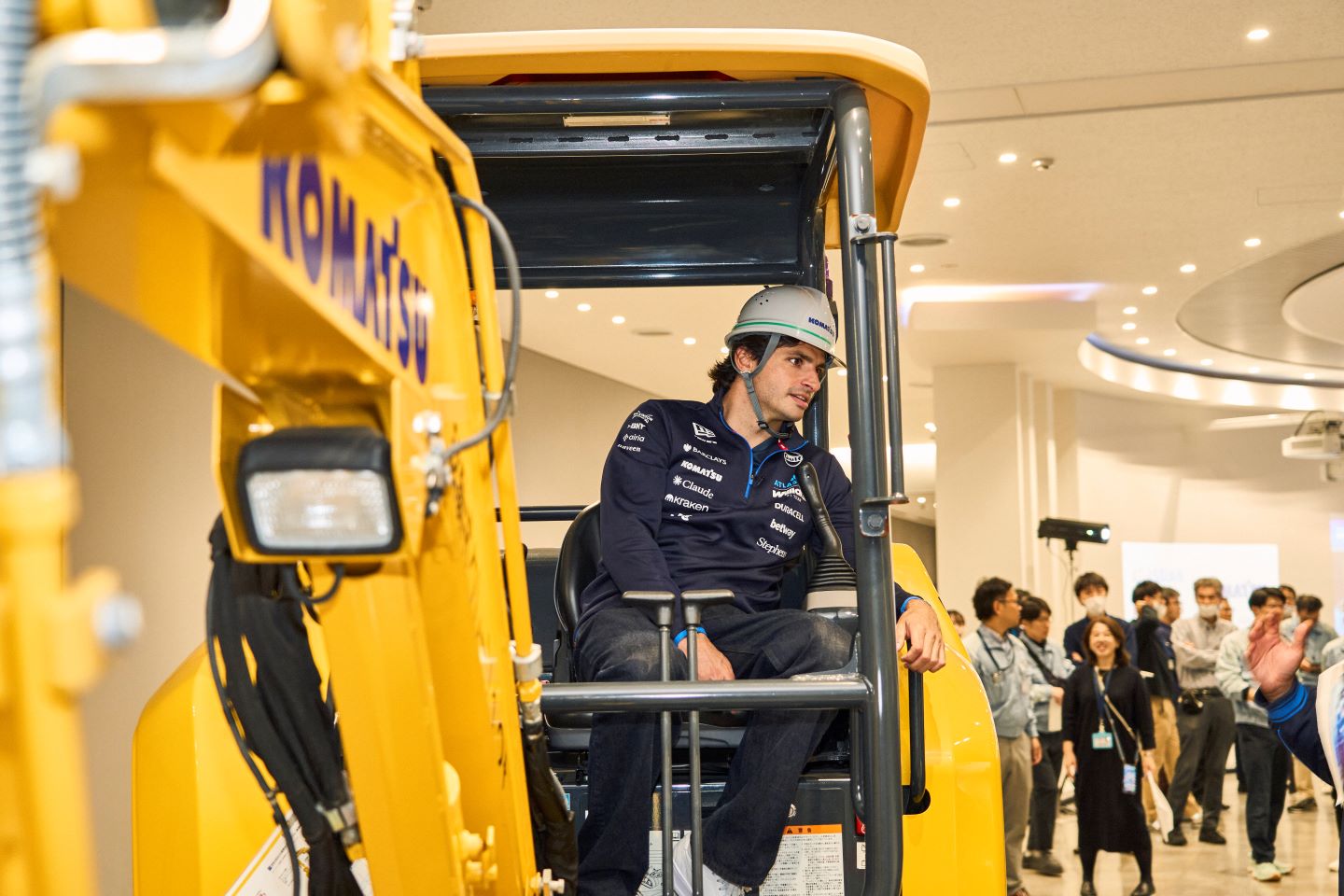


When precision has to perform

How do teams improve performance when the margins for progress keep getting smaller? On a racetrack and on a jobsite, the answer often starts the same way: Listen closely to the people doing the work, study the data and keep improving the system one decision at a time.

Ahead of the 2026 Japanese Grand Prix, Atlassian Williams F1 Team Driver Carlos Sainz and Chief Technical Officer Pat Fry visited Komatsu’s Shonan Plant. For Williams, performance depends on fast learning cycles, specialized teams and decisions made under pressure. The visit brought together two very different engineering environments, each shaped by precision, collaboration and the need to turn ideas into measurable results. For Williams, performance depends on fast learning cycles, specialized teams and decisions made under pressure. At Shonan, engineers apply similar disciplines at an industrial scale, developing equipment and technologies designed for demanding work sites. The scale is different. The mindset is familiar.

Carlos Sainz gets the feel of another vehicle that, like his FW48 race car, is painstakingly designed to deliver consistently excellent performance in demanding conditions.

A welcome rooted in shared curiosity

Team members at the Shonan Plant welcomed Sainz and Fry with Atlassian Williams F1 Team flags before the group toured the facility and met with Komatsu engineers.

Inside the Shonan Innovation Lab

At the center of the visit was the Shonan Innovation Lab, a research and development facility opened in 2023. Designed to house approximately 640 engineers across more than 10,000 square meters, the lab reflects a practical idea: Innovation improves when people can collaborate easily and focus deeply. Open workspaces support spontaneous problem-solving. Dedicated focus areas give engineers space for detailed work. Together, the environment is designed to help teams move from insight to testing to improvement.

Fry said the purpose of the facility stood out. “I’ve been in motorsport for 39 years now,” he said. “Two things keep me excited. One is obviously winning races, but the other is technology and the research that goes into it. So, I’m really interested to see what you’re doing here and dig into some of the details and talk with you about it.”

Finding connection through friendly competition

During the visit, Sainz joined others for several rounds of hanetsuki, a traditional Japanese shuttlecock game played with hagoita paddles, including a match against the plant manager, who won.

Ideas that move from data to decisions

One stop on the tour introduced KELK thermoelectric technology, which uses temperature differences to generate electricity and can also support precise heating or cooling applications. The demonstration sparked questions about where similar principles might be useful in other high-performance environments. Fry noted that the technology could inspire thinking about applications such as cooling batteries through early curves. Sainz also reacted to the demonstration with curiosity. “Super interesting,” Sainz said. “This is impressive. I didn’t know this existed.”

The exchange reflected one of the most valuable parts of the partnership; not a claim that two industries solve the same problems, but an opportunity for teams to compare how they test, learn and improve.

Exploring thermoelectric technology

Among those details were a demonstration of KELK thermoelectric technology that can generate electricity from temperature differentials, electricity that can be used to heat or cool surfaces. Fry remarked it might have an application to “cool batteries in the early curves or some other fun things we can do.”

Why data matters in every performance environment

Fry also met with Shonan engineers who specialize in autonomous equipment design. Their conversation focused on areas where many advanced industries are moving in the same direction: data collection, modeling, simulation and optimization.

In racing, a small adjustment can affect lap time. In construction, mining or other job site environments, a small improvement can influence productivity, energy use, safety or machine availability. In both cases, better decisions depend on better information. “You can’t rely on empirically guessing,” Fry said. “You’ve got to get hold of the data, analyze it and make the right decisions.”

Sharing a passion for innovation

Pat Fry also had a chance to discuss design challenges and how data, modeling and simulation shape autonomous equipment development.

Built to win the innovation race

The visit to Shonan demonstrated how partnerships can create value by giving people the opportunity to explore new ways of collaborating. For engineers, performance is rarely the result of one breakthrough. It is built through curiosity, testing, collaboration and the discipline to keep improving. Whether the challenge is on a race circuit or a job site, progress depends on teams willing to learn from each other and apply those insights with care.

As Sainz and Fry experienced, the connection between Atlassian Williams F1 Team and Komatsu goes far beyond branding. It suggests that the future will be shaped by teams willing to challenge the limits of their own fields and their own imaginations.


Latest articles

55 Questions with Carlos Sainz at Komatsu Shonan Plant
Challenge drives us beyond the limit.
Building future engineers through real experiences