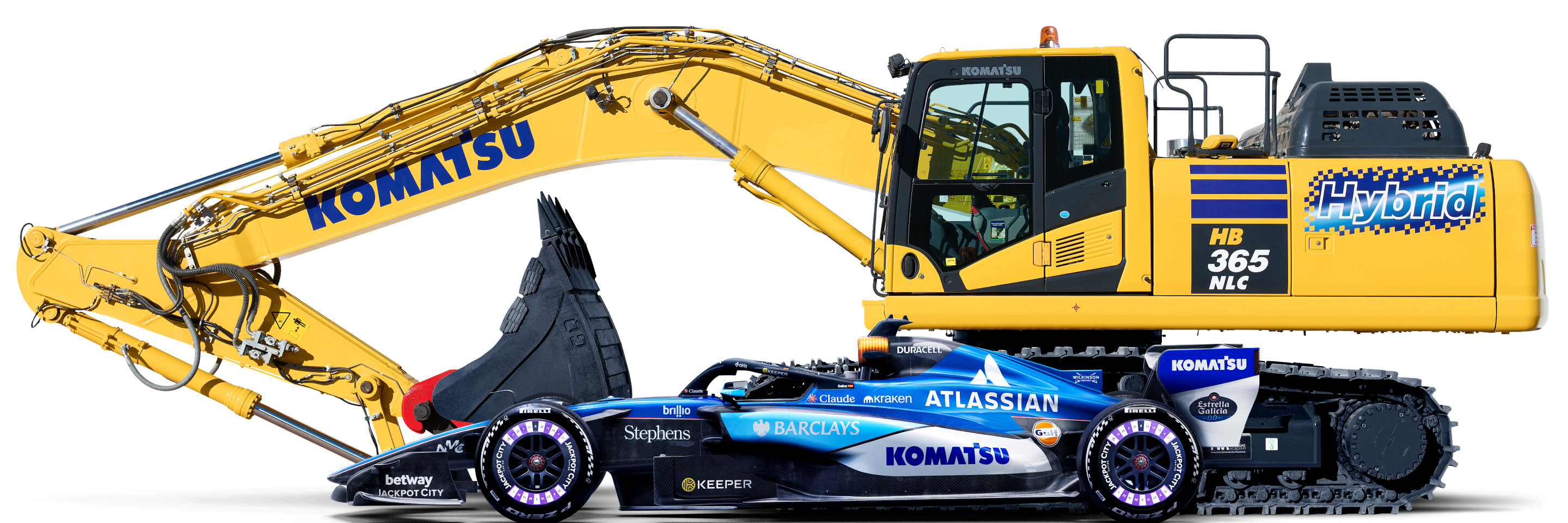
The goal is engineering a system that doesn't waste energy. At construction sites where Komatsu's hybrid excavators work and on circuits where the Atlassian Williams F1 Team's cars race, our machines face totally different environments and demands on performance and speed. Yet, both share the challenge of hybrid technology: taking efficiency and performance beyond the limits. Same challenge, shared ambition.

Two hybrid systems, each with its own paths of evolution.

At construction sites where work piles up everyday…
Komatsu's hybrid system
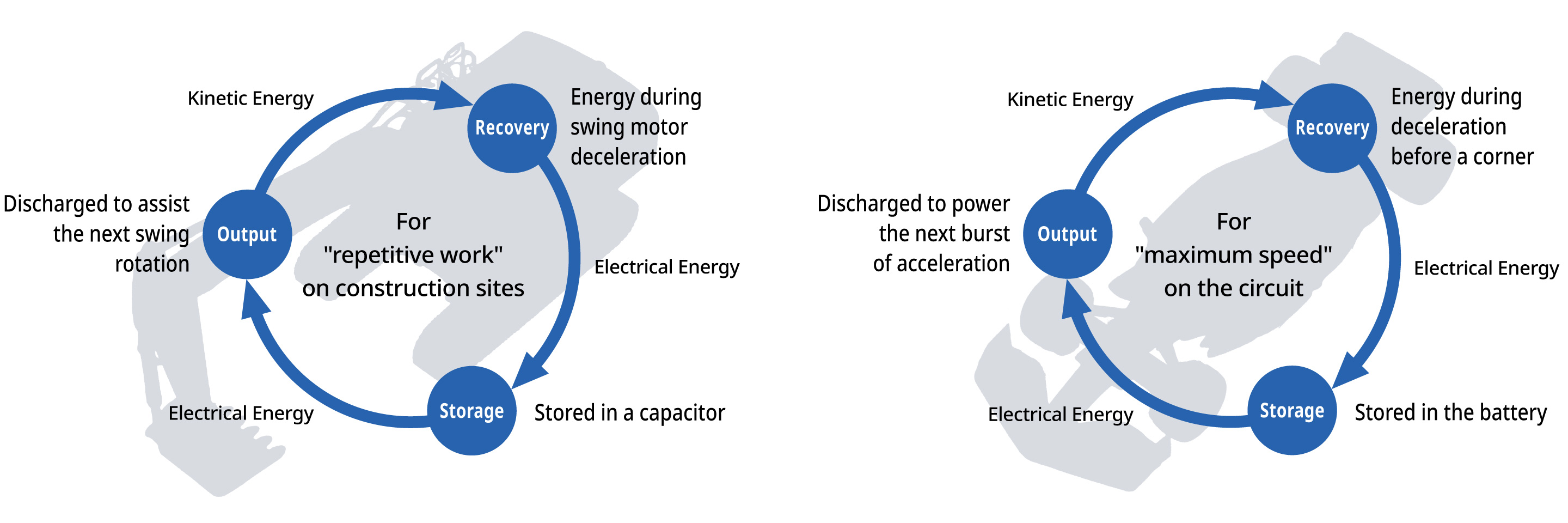
Taking our hydraulic excavator as an example, a key feature of Komatsu's hybrid system is the electric swing motor-generator that rotates the upper structure. Energy generated during rotational deceleration is recovered, stored as electricity, and reused for the next swing motion or to assist high-load engine work. The reduced fuel consumption lowers both environmental impact and operating costs.

On circuits where speeds exceed 300 km/h…
Atlassian Williams F1 Team's hybrid system
Race car hybrid systems are based on a different approach from construction machinery. In a race, kinetic energy usually lost during deceleration and braking is recovered and stored as electrical energy. Then during acceleration such as exiting corners, this stored energy can be discharged and reused to boost power. The hybrid system efficiently manages these repeated cycles of recovery and discharge.
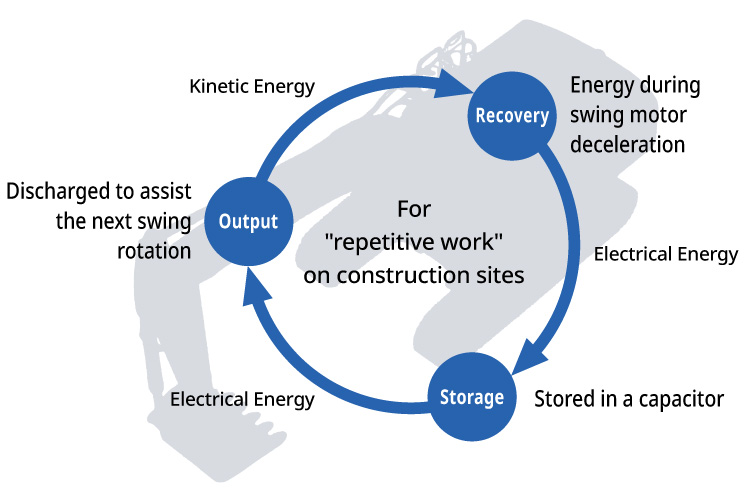
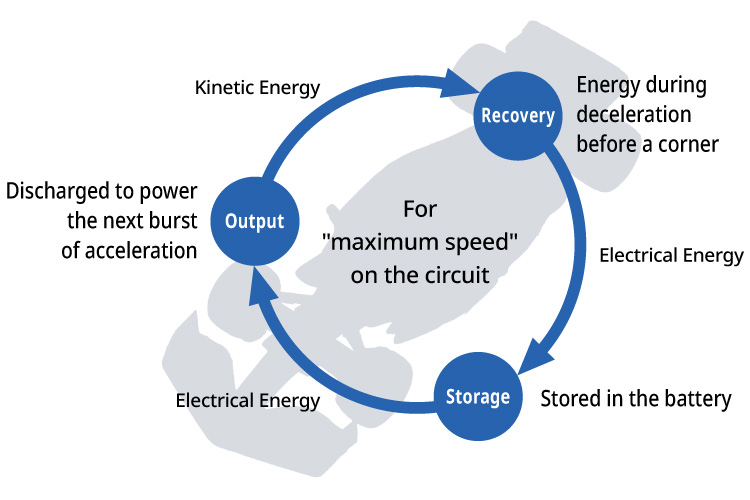
Construction machines work. Race cars race.
Each seeks to excel in their unique environments.
Both pursue the ultimate in hybrid technology: the challenge goes on.
Whenever Komatsu construction machines are moving earth, and Atlassian Williams F1 Team race cars are racing, the challenge is the same for both. These two engineers from these very different worlds are on their way to a common goal.