Redefining presence: How teleoperation is changing work in heavy industry

  
2026.7.10
Innovation

Redefining presence: How teleoperation is changing work in heavy industry


Teleoperation allows skilled operators to control heavy equipment from safer, more connected environments. For mining and construction teams, the shift is less about distance and more about keeping people connected to the work, without requiring them to be physically in the machine.


It started with a challenge on the jobsite

In mining and construction, the work has always demanded proximity. To operate a machine, you had to sit inside it. To solve a problem, you had to be on site. That reality came with tradeoffs: long travel times, exposure to harsh environments and limits on who could do the work. “Today the world is putting the person into the center more frequently than in the past,” Alvar said.
Teleoperation didn’t begin as one single innovation. It began as a response, a way to move people out of harm’s way without losing control of the work.

In reality, that thinking isn’t new; Komatsu has long been exploring remote operations. What’s changed is the technology and the urgency behind it. At sites like Anglo American’s Minas-Rio operation in Brazil, that challenge was practical and immediate.

“When we execute these operations with a manned dozer, it’s necessary that the crushing process actually comes to a halt … it’s a question of safety,” said César Carraro, Mine Services Coordinator. The question became simple: could the work continue without putting people in that position?

The first shift: Distance becomes possible

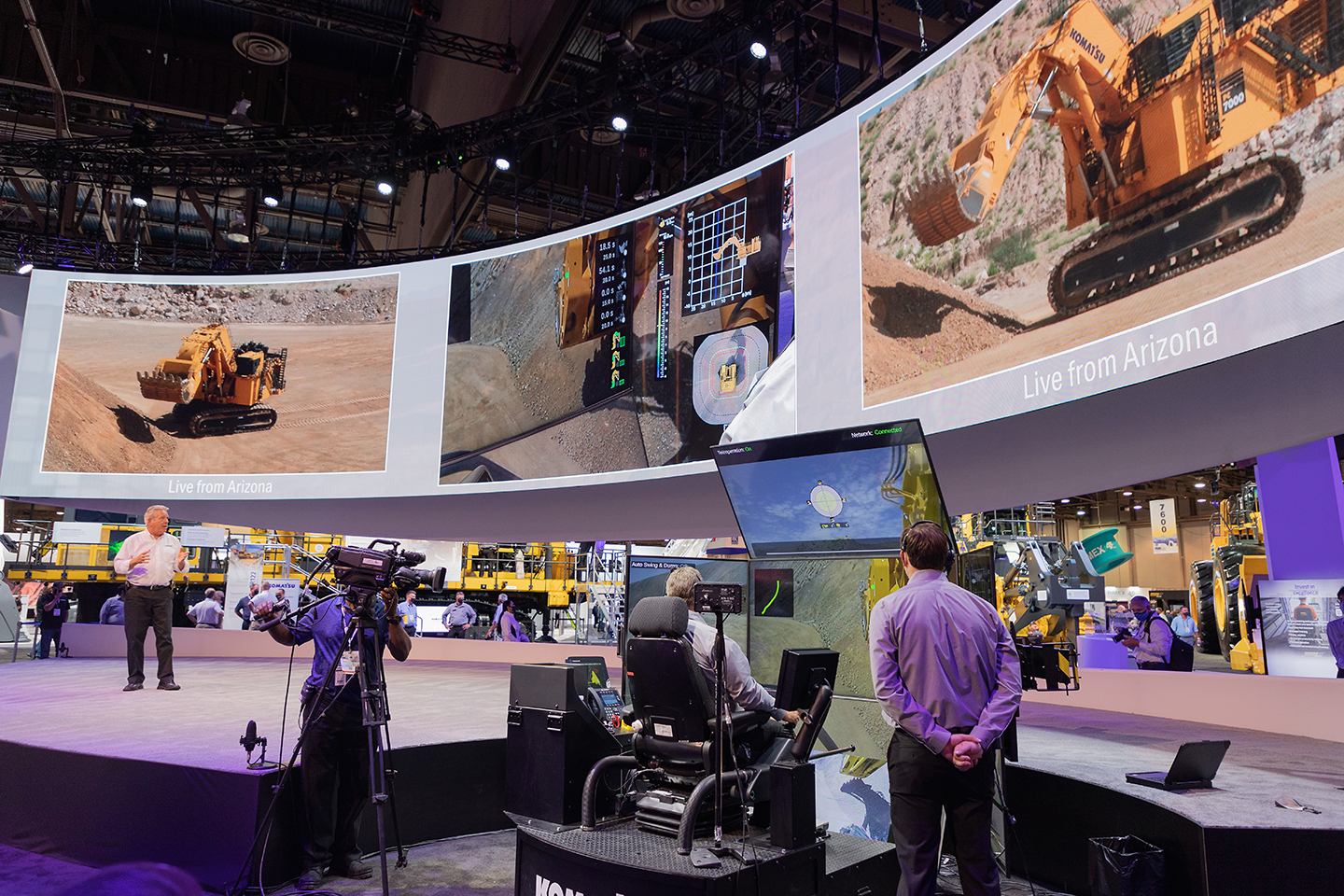
A live demonstration at MINExpo highlighted an operator controlling a mining excavator from hundreds of miles away in real time. It was a visible moment, but the idea had been building for years.Remote operation allows work without being physically present at the site. What was once tied to a location could now be done from anywhere, while increasing precision, control or accountability.

Proving it works, in real time

At MINExpo 2021, Komatsu demonstrated for the first time what teleoperation could do under pressure. An operator on the show floor was controlling a PC7000 mining excavator at the Komatsu Proving Grounds in Arizona, more than 695 km (432 miles away). “We operated that shovel remotely … in front of a live audience,” said David Haukeness, Chief Architect at Mining Technology Solutions. The demonstration required complex network infrastructure, coordination and precision and it worked without interruption.

Removing people from the environment, not the work

The first impact of teleoperation was immediate: safety.

Machines operate in environments defined by dust, noise, vibration, instability and inherent risk. For operators, those conditions weren’t temporary, they were daily.
“The operator is not now affecting to a very aggressive environment with plenty of dust, noise and vibration,” Alvar said. “Thanks to teleoperation, now we take away the operator from the risk.”

“You’re taking the operator out of harm’s way … and putting them in front of a screen,” Li added.
The work doesn’t change. The machine still digs, pushes and drills. But where the person sits and what they experience is fundamentally different.

Safety, without stepping away

Remote operation removes the operator from the environment, not the responsibility. “We can avoid that impact to the health,” said Javier Matsuda, who joined Komatsu after working in telecommunications and now supports solution development across regions.

Operators now work from control rooms rather than inside the machine itself, maintaining visibility through cameras and real-time data. The operator still sees the machine, still makes decisions, still controls the outcome — but now does it from a place designed for focus.

What began as safety became something bigger

Once operators were no longer tied to the machine, new possibilities emerged.

In remote regions, travel time had always been part of the job, hours spent moving people to machines and back again. “All that time the machine used to be stopped … now is available hours where the machine can be operated,” Alvar said.  Teleoperation didn’t just remove risk. It removed downtime. It changed how time was used and how work was structured. “The first thing we noticed… was a gain in production,” Carraro said.

But the bigger shift wasn’t operational. “Not having to go to the site is so much easier,” said Ibuki.
A simple statement, but one that reflects a deeper shift. Work was no longer defined by where it happened.

A different kind of workday

The job hasn’t disappeared, it has moved. Operators now work in controlled environments, closer to home, with better visibility and less physical strain.

“This technology can improve the quality of life of the operator,” Javier said. That shift also reduces time spent commuting to site and waiting between shifts, allowing operators to stay closer to daily life.

Access changes everything

When presence is no longer defined by location, the boundaries around who can do the work begin to shift. Roles that once required physical proximity now depend more on awareness, judgement and the ability to interpret information across systems. What it means to operate a machine is evolving, and will continue to.

For projects like Minas-Rio, that shift has expanded who can safely and effectively take part in operations, demonstrating how access and inclusion grow alongside the technology itself. The door is now opening to people who may not previously have seen a place for themselves in heavy equipment industries.

Opening the door to more people

When the job changes, the workforce changes with it.

Heavy equipment operation has traditionally required specific physical conditions and on-site presence. Teleoperation removes many of those barriers. Li said, “Anybody can operate a machine, you just need to know how to use a computer.”
That shift expands who can participate. It allows more people to step into skilled roles and creates new pathways into the industry.

At the same time, the nature of the role is evolving. And in real-world applications, the impact is already visible.
“The teleremote project has arrived to include women as bulldozer operators,” said Juliana Cruz, an infrastructure operator at Anglo American. “It takes away the risk because you’re in a room, comfortable … with great vision … without the risk.”
The work becomes less about physical operation and more about oversight, coordination and decision-making. “We believe this will create workplaces where people can work more easily, enjoyably and with greater positivity,” Ibuki said.

Seeing the jobsite differently

“I am involved in systems such as the PC200i-12 excavator, which integrates remote operation, automation and data.
I believe that Smart Construction remote operation and automation solutions will become the core for solving challenges at construction sites and creating new value,” Ibuki said. The jobsite becomes something you can see, understand and improve, without being physically there.

Behind the scenes, a different kind of system

Making this shift possible required more than machines. It required people across roles and regions – engineers, developer and operators – working together to build something that didn’t exist. “All of our software products … require a network to function,” Haukness explained.

The systems behind teleoperation are complex, requiring machines, data, cameras and communication working together in real time. But what stands out is how they were created: through collaboration, iteration and a willingness to learn as the technology evolved.

Haukness said, “Komatsu values its people … we were all kind of figuring it out together.” The technology evolved and so did the people behind it. “I came in as a pre-sales engineer … now I’m chief architect,” he said.As the technology evolved, so did the people behind it, building new skills, new roles and new ways of working across regions.

A global system, built by people

Smart Construction teleoperation is not a single product. It’s a system shaped by teams around the world engineering networks, designing interfaces and supporting operations in real time.

“They treat all of their employees as valuable assets to the company,” Haukness said. That trust enables people to contribute across roles, regions and disciplines.

What it’s leading to

Teleoperation is not the end state. It’s part of a broader transition.

Li said, “Automation is the future … everything related to autonomous is what we’ll be seeing.” As systems become more advanced, the operator’s role continues to evolve, from controlling a single machine to managing systems, workflows and outcomes.

But even as the technology advances, the direction remains consistent. “It’s not just about efficiency,” said Ibuki. “t’s changing the very nature of how we work.”

Presence, redefined

Teleoperation began as a way to reduce risk. It became a way to improve how people work. And it continues to expand what’s possible — connecting expertise across distances and opening new paths into core industries. The shift is bigger than the technology itself. It’s a shift in how work is defined. From being tied to a place, to being defined by contribution. From proximity, to presence.

Because the goal was never just to move machines. It was to create a better way for people to be part of the work — wherever they are.


Latest articles

Technology changes jobs. People transform what comes next.
Komatsu-Williams Engineering Academy: Grove Experience 2025
How engineers test ideas before the work begins