2026.2.27
Innovation

How engineers test ideas before the work begins


Digital twins help Komatsu teams reduce risk and make better decisions before machines ever reach the field

Building heavy equipment leaves little room for trial and error. A mistake discovered too late costs time and materials and can put people at risk. So before a new machine ever operates in the real world, engineers need a way to test its behavior in the most challenging conditions. But how do you test something before it exists? For engineers like Koji Inada, the answer is to build a digital twin: virtual versions of machines and worksites that help teams test, learn and improve before anything takes shape in the real world.


“To minimize risks, I place great importance on thoroughly examining every detail during the experimental phase, formulating hypotheses and conducting repeated verification,” said Inada, an engineer based at Komatsu’s Awazu plant in Japan.

Inada joined Komatsu in 2010, fresh from completing his master’s in Material Production Science. At that time, he expected to apply his skills in welding research. But one walk through the Awazu facility changed everything.

“I was amazed to see welding, a specialized process, being automated at such a high level,” he said. “This experience made me keenly aware of the significant impact robots have on manufacturing sites and sparked my strong interest.”

At Awazu, Inada uses digital twins to simulate both the robotic welder and the factory floor it operates in. This allows him to test how the machine will move, weld, and work alongside people — all in a virtual environment. Once the simulation looks right, it’s translated into real-world instructions using Komatsu-developed systems that help monitor and guide the robot’s performance.

What started as a local innovation is now used at Komatsu facilities around the world. And Inada’s experience is just one example of how manufacturing has evolved, where robotics, simulation and digital tools are now part of everyday problem-solving.

Komatsu robotic welding machines at work at the Somersby, New South Wales, Australia manufacturing facility.

At Komatsu, innovation doesn’t just create better machines, it creates new paths for people. In São Paulo, Francisco Denes da Silva is proof of that. He joined Komatsu do Brasil in 1997 as a manufacturing assistant, and over the course of 28 years, trained and grew into a specialist in robotic welding. Today, he’s a Manufacturing Technician helping drive the future of smart production.

“I learned how to program and operate the robots, and acquired knowledge about all their functions,” he says. His experience now spans every aspect of Komatsu’s automated welding process — from preparing workpieces to optimizing precision and output.

The welding robots are more than machines with mechanical arms, he explains, they’re critical to producing parts with consistent quality, speed and safety. “They ensure greater efficiency, quality and productivity.”

Across Komatsu, that efficiency doesn’t replace skilled human work, it enhances it. For Da Silva, it’s been a career built on continuous learning, and proof of how automation and people grow together.

The same approach that’s reshaping work on the factory floor is extending far beyond it, as well. Digital twin technology is being used to help Komatsu customers model jobsites, monitor mines and explore how machines might perform in extreme environments. In every case, the intent is the same: reduce uncertainty, improve safety and give people clearer insight before work begins.

Seeing the job before it starts

Jason Anetsberger has spent much of his career trying to answer the same question: how do you help crews make better decisions before small problems turn into costly ones?

He started at Komatsu as a Marketing Engineer, then moved into work focused on automation for bulldozers and excavators using GPS sensors. Over time, that focus expanded beyond individual machines to the entire jobsite.

“Almost from that first year until today, I've been exploring how we can marry digital and machine automation and cloud solutions to make sure we're offering our customers a better way to do the work they do,” said Anetsberger, Director of Customer Solutions at Komatsu North America.

Among those solutions are several that utilize digital twins to build a replica of a jobsite to better understand the work ahead and how the machines perform in the field.

“We are actually measuring and monitoring the production of individual machines and trucks — how much they haul, how much earth they moved,” he said. “So we can visualize, analyze and report on that. But we're also able to then simulate questions like, ‘What should that machine be able to move?’ And then think about how that plays out in terms of project schedules.”

The work goes beyond visualizing and reporting actuals, it’s also about using that knowledge to predict the future and help customers optimize their mix of machinery, Anetsberger said. “If we find out that there's an extra 10,000 cubic yards of earth to be moved or a million cubic yards in this next phase of the project, how many of these machines do we need? Or, what size do we need to get that done in the allotted time frame?”

Supported by digital learnings, Komatsu works with customers to determine the best approach before moving any dirt at all.

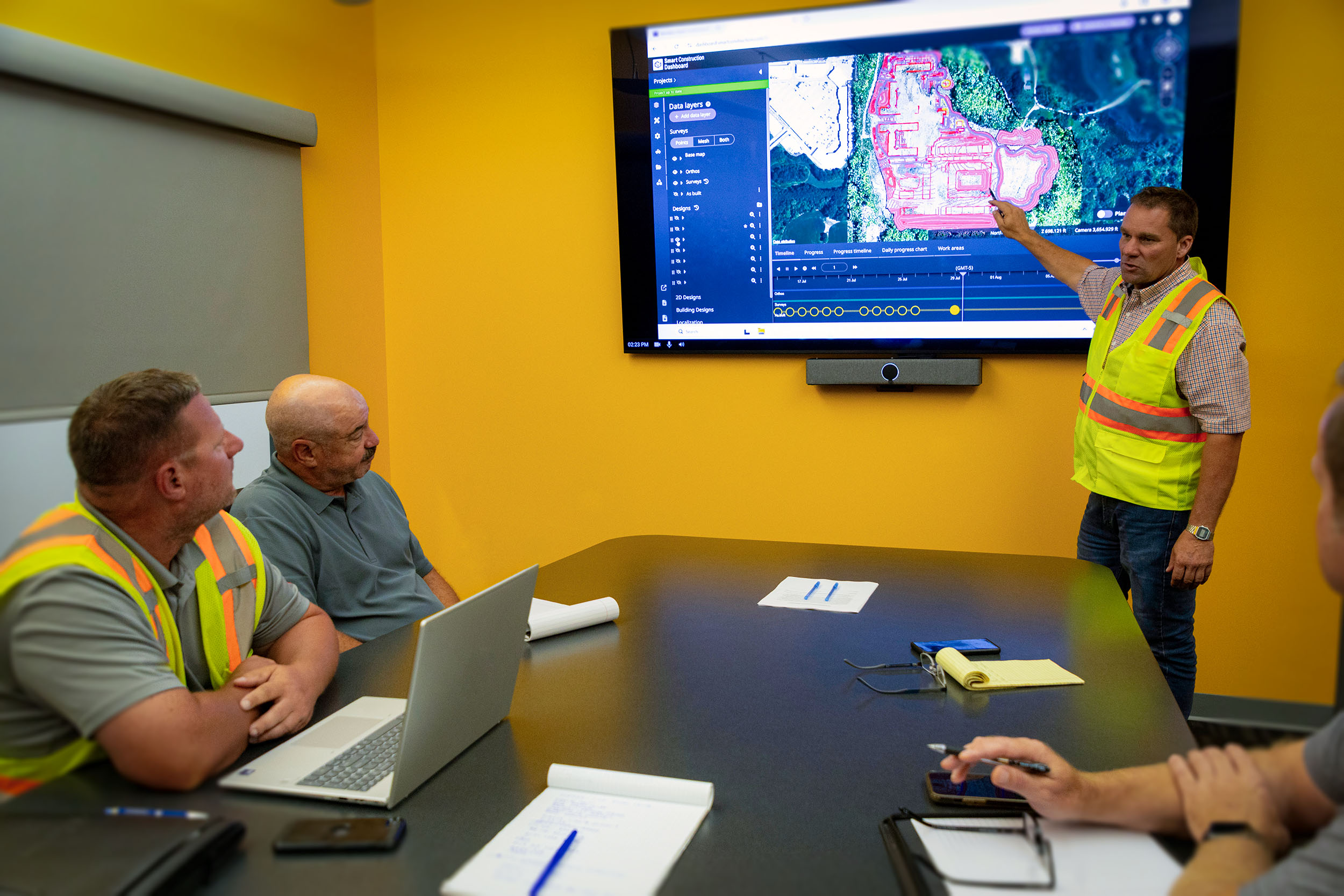
On a jobsite in the U.S., a project manager walks the team through real-time productivity data using Komatsu’s digital twin tools — turning site activity into insights they can act on from anywhere.
Smart Construction, developed in part by Earthbrain — a Komatsu joint venture — brings together data, sensors and automation to help job sites run more safely and efficiently. Just like smart devices help people manage their homes, these tools help construction teams better understand their environment, equipment and progress.

At Earthbrain, Komatsu’s joint venture focused on digital transformation, Global Development Manager Talha Khalid sees the power of digital twins come to life through Smart Construction tools. They can bring together jobsite data — from terrain scanned by drones to machine movement tracked in real time — into a single, intuitive view. 
Teams can monitor operations remotely, adjust to changes as they happen, and compare performance against the digital plan to make smarter decisions going forward. For Khalid, it’s not just about collecting data — it’s about giving people clearer insight into what’s happening on the ground, so they can build safer, faster and with more confidence.

When safety depends on what you can’t see

Digital twins are also used to help protect people working in some of the most demanding environments on Earth. At Komatsu’s Mine Site Technologies (MST), teams create virtual versions of underground mines to better understand what’s happening below the surface, where visibility is limited and conditions can change quickly. Real-time data helps teams spot potential issues before they become hazards.

“There’s no GPS underground, it’s dark, it’s humid, it’s everything,” said Ramodh Rangasamy, Global Product Manager at MST. “The product being built for that environment needs to be robust and work for decades, not years. That challenge appealed to me.”

Many underground mines are located far from traditional infrastructure, making reliable communications onsite critical. Digital twins help bring together data from equipment, sensors and people into a single view of the mine. That view helps customers understand where their assets are and what they’re are doing, as well as where their people are, what they’re doing and what are the conditions of the working environment.”

For an underground mine with an autonomous vehicle that hasn’t come back when expected, for example, Rangasamy said, a digital twin can help determine why it may be stuck in a location, including whether it’s waiting on other machines or personnel to clear an area, if there was a mechanical breakdown, or if it’s something requiring greater intervention.

“There are multiple modules that come together to unlock this digital twin for the mine. And it's not different pieces of software that need to come together, it's that single ecosystem that can capture all this information and then start to provide context,” he said.
Komatsu’s use of digital twins can take on many forms, including this simulator used in Sudbury, Ontario, Canada, to demonstrate underground hard rock equipment.

Behind the machines

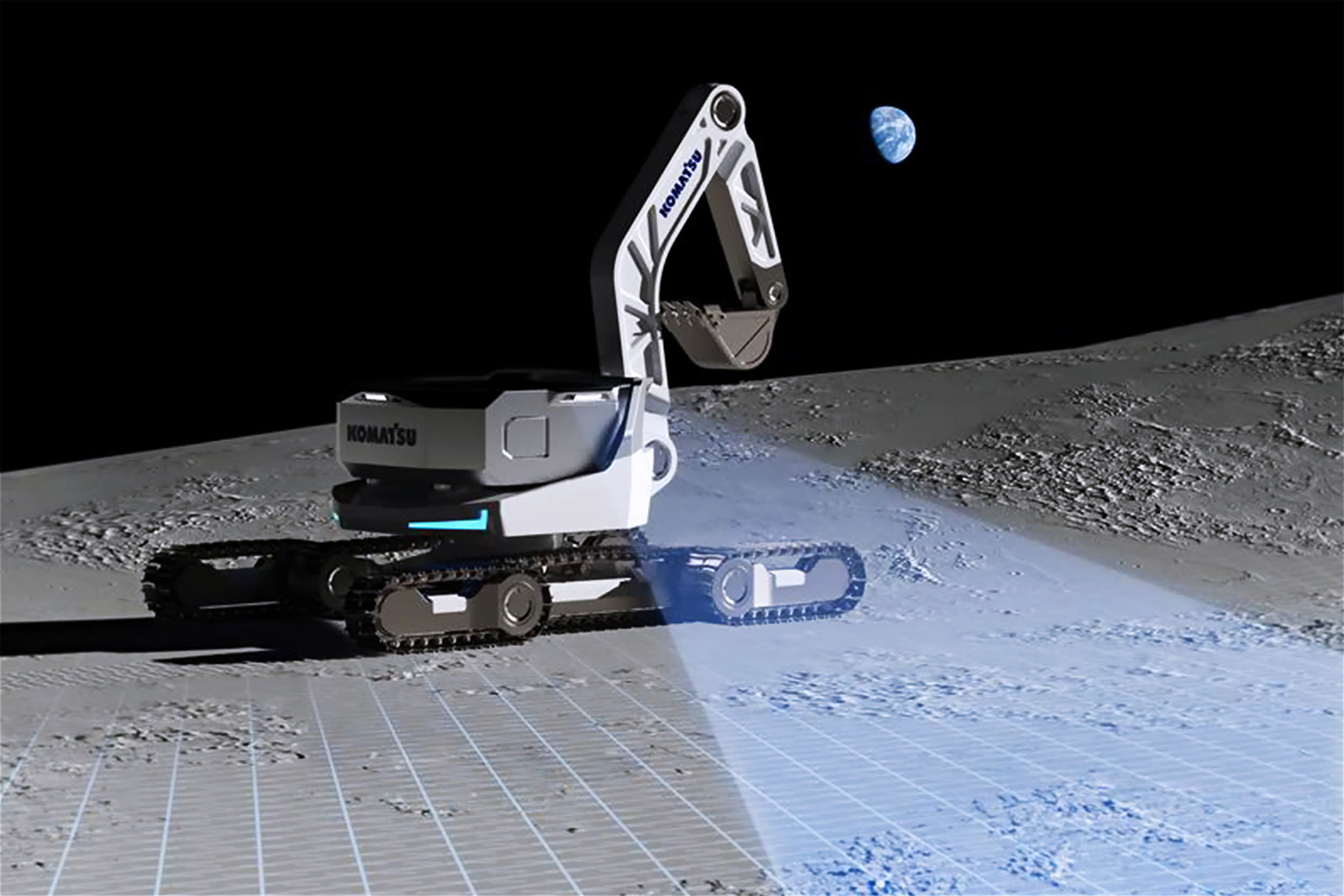
But perhaps the biggest promise of digital twins is the places it can take us next. Komatsu is currently developing lunar construction equipment — equipment that has to be fully designed, tested and validated before it ever leaves Earth. How do you create lunar-ready equipment before actually putting it on the moon? You create virtual equipment and put it on a virtual moon.

Komatsu is working to send an excavator to the moon, but to get there, a digital twin will be needed to prove it can work.

The technology Komatsu uses to build digital twin environments uses a range of data, including terrain and environmental conditions. Lunar construction equipment can help space agencies and private companies build moon bases and other outer space construction projects, but the moon has wild temperature extremes and no atmosphere. The 3D reconstruction of the moon can take all of these factors into account.

That’s where the virtual equipment comes in. A digital twin utilizes the equipment as a platform. This equipment, in real life, can be used to test maneuvers and behavior. Modifications can be made to the real-life hardware, as extensive testing in the digital environment helps build confidence in potential solutions. The digital twin can also help refine remote management of lunar equipment, where the 383,000 km (238,000 mile) distance to the moon can cause delays in communication of a few seconds. This delay is around 2.5 seconds total, but every second counts in an extreme environment.

The moon represents one of the most extreme environments Komatsu wants to build equipment for and with the support of digital twin technology, that possibility is becoming increasingly real. Across many use cases and environments, the virtual work happening today is laying the groundwork for safer, smarter and more resilient jobsites tomorrow. By applying digital insight early in the process, Komatsu is helping improve outcomes not just for our customers, but for the communities and industries that rely on what we build. The models may be digital, but the progress is very real.


The Challenge to Space | Our project story

Komatsu's development of lunar construction equipment is contributing to the realization of humankind's dream. 

Learn more


Latest articles

Reclaiming value: The Maybach reclamation story
Innovation beyond borders
Innovation

How engineers test ideas before the work begins