Oct. 23, 2026
Komatsu Ltd. (hereafter “Komatsu”) (President and CEO: Takuya Imayoshi) has launched the PC200i-12, a 20-ton-class hydraulic excavator designed to accommodate tiltrotators.
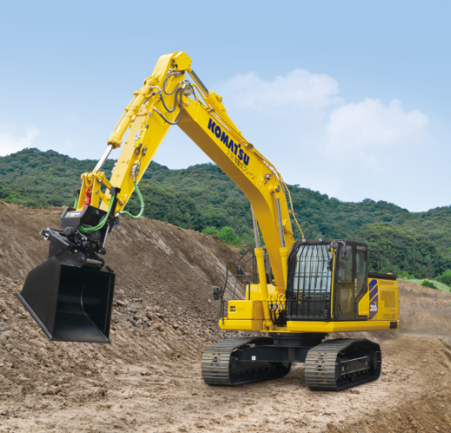
【PC200i-12 hydraulic excavator with tiltrotator compatibility】
Based on the PC200i-12, Komatsu's first software-defined vehicle (SDV)*1 hydraulic excavator, which was introduced in Japan in December 2024 and subsequently in Europe, North America, and Australia, the new model has been developed to accommodate tiltrotators and enable the use of Komatsu's proprietary 3D machine control (3DMC) functions when a tiltrotator is installed*2.
In recent years, interest in tiltrotators has been growing worldwide, driven by the need to address labor shortages and improve productivity and safety at construction jobsites. Adoption has progressed particularly in Europe, while their use is also expected to contribute to labor savings and greater construction efficiency in Japan. A tiltrotator is a device mounted at the end of a hydraulic excavator’s arm that enables attachments such as buckets to tilt from side to side and rotate 360 degrees. Tiltrotators are used in a wide range of applications, including road and utility pipe construction, building foundation work, slope shaping, and grading around obstacles. By allowing operators to flexibly adjust the angle and orientation of attachments, tiltrotators enable work across a wider area while minimizing the need to reposition the machine, even in situations that would otherwise require the machine to be moved or its direction changed. They also facilitate attachment changes, potentially reducing the need for additional workers or dedicated equipment previously required to assist with attachment installation and removal. These benefits contribute to labor savings and lower operating costs at construction jobsites.
However, installing a tiltrotator adds tilting and rotation movements to the four conventional excavator movements—boom, arm, bucket, and swing—requiring operators to coordinate six axes of movement. This makes operation more complex and requires a certain level of skill and experience to master.
To reduce the complexity of these operations, Komatsu collaborated with three leading tiltrotator manufacturers— Rototilt, Steelwrist, and Engcon—to jointly develop specifications that facilitate the installation of their respective tiltrotators on the PC200i-12 compared with previous models, as well as systems that enable integration between each manufacturer's tiltrotators and Komatsu's proprietary 3DMC technology.
【Tiltrotators from Rototilt, Steelwrist, and Engcon (from left)】
In addition, leveraging its in-house developed 3DMC technology, Komatsu has developed unique functions that integrate control of the excavator and tiltrotator. Using information obtained from sensors installed on the tiltrotator, the system automatically controls tilt, rotation, and bucket movements, assisting operators with tasks that would otherwise require multiple simultaneous operations.
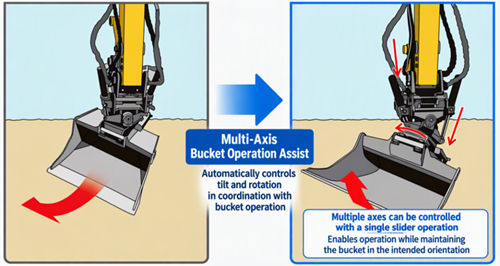
In addition to conventional 3DMC functions for tiltrotators, Komatsu has developed two proprietary functions: an attachment posture holding function*3, which maintains the operator-selected orientation and angle of an attachment at the push of a button, and a multi-axis bucket operation assist function*4, which automatically controls tilt and rotation movements in coordination with bucket operation during scooping and dumping.
These functions help simplify the complex operations associated with tiltrotators, reducing operator workload while supporting easier and more precise construction work.
Going forward, Komatsu will continue to leverage the advantages of SDVs, which enable ongoing enhancements to machine functions and performance through software updates, to expand the integration of ICT functions with tiltrotators and other attachments. By making advanced operations easier to perform, Komatsu aims to contribute to improved productivity and reduced labor requirements at construction jobsites.
*1 Software-Defined Vehicle (SDV):
A vehicle whose functions and performance can be flexibly updated through software updates.
*2 Related news release:
https://www.komatsu.com/en-za/newsroom/2024/3d-construction-function-standard-new-generation-hydraulic
*3 Attachment posture holding function:
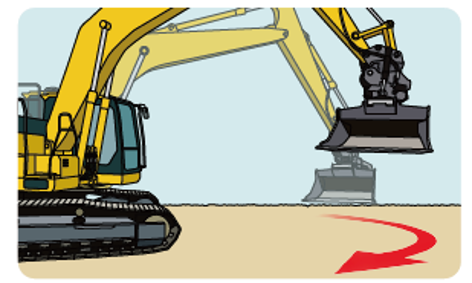
Conventionally, maintaining an attachment's orientation and angle while performing work required operators to coordinate six axes of movement: tilt, rotation, bucket, boom, arm, and swing. With this function, pressing a button on the work equipment control lever enables the machine to automatically maintain the selected attachment orientation and angle while the operator controls only three axes—boom, arm, and swing—supporting operations such as material handling.
*4 Multi-axis bucket operation assist function:
Conventionally, scooping and dumping operations required operators to coordinate three axes of movement: tilt, rotation, and bucket. With this function, operators can automatically control tilt and rotation movements using a single slider on the work equipment control lever, enabling scooping and dumping while keeping the bucket opening oriented in the intended direction. This reduces the operational workload associated with scooping and dumping, which are frequently performed at construction jobsites.
(end)
No : 0072(3485)
Corporate Communications Department
Sustainability Promotion Division
Komatsu Ltd.
tel: +81-(0)3-6849-9703
mail: JP00MB_cc_department@global.komatsu
*The information may be subject to change without notice.


